
Merry Christmas!
Think of someone you admire. It could be for any number if reasons.

Despite his great accomplishments, “Elijah was a human being, even as we are” (James 5:17a). The Christians of the New Testament days looked up to Elijah. They placed him on a pedestal just as we often do with people we admire.
Priscilla Shirer writes that “the pedestal ascribes unrealistic standards to them. By idolizing someone, I run the risk of crippling them…I make it harder for them to freely explore the far reaches of their faith, out where they risk exposing their frailty by leaning on the grace and goodness of God…” (2022, p.17).
When I read this today, I thought of Erika Kirk, the widow of Charlie Kirk. I have heard a lot of people makes statements that clearly place her on a pedestal as a woman leaning into her faith through the most horrific of circumstances. I am guilty of putting her upon that pedestal as well. The higher she is lifted onto that pedestal, however, the heavier the pressure upon her must feel.
I don’t know quite how to end this today other than to share three things.
https://bible.com/bible/111/jas.5.17.NIV
Shirer, P. (2022). Elijah: faith and fire. LifeWay Press.
How do we attain the powerful faith of Elijah? According to Priscilla Shirer in her Bible study, Elijah: Faith and Fire, we purposely persevere through whatever physical and spiritual battles arise in our path with our eyes always on the goal of following God’s will. Our faith will grow along the way.
“The process of working towards these goals will not be easy. In fact, I can assure you, it will step on your toes now and again. But still, it will be worth it” (Shirer, 2022, pg. 14).
As I said yesterday, I have barely started Priscilla Shirer’s Bible study Elijah: Faith and Fire, but I can already tell it’s going to be a good one. I invite you to join me as I work my way through it. Better yet, join Priscilla on your own or with a small-group to study it yourself.
Shirer, P. (2022). Elijah: faith and fire. LifeWay Press.
https://bible.com/bible/111/jas.1.12.NIV
When you think of the story of Elijah, do you, like me, think of the spiritual battle of two alters that took place on Mount Carmel? If you don’t know the story, click this link to read it. https://bible.com/bible/111/1ki.18.19-39.NIV
Was Elijah blessed with instant faith from birth without going through any trials to learn it? That’s pretty doubtful, but wouldn’t it be nice if we could do that. “Everyone wants the glory, but few are willing to pay the price required to get it” (Shirer, 2022).
First Peter chapter 5, verse 10 (NIV) says, “And the God of all grace, who called you to his eternal glory in Christ, after you have suffered a little while, will himself restore you and make you strong, firm and steadfast.”
Am I will…
Are you willing…
Are we willing to do what Elijah did prior to the victory at Mount Carmel to have that kind of faith?
I have barely started Priscilla Shirer’s Bible study Elijah: Faith and Fire, but I can tell it’s going to be a good one. I invite you to join me as I work my way through it. Better yet, join Priscilla on your own or with a small-group to study it yourself.

Shirer, P. (2022). Elijah: faith and fire. LifeWay Press
What is my reputation?
What do people think when they hear my name?
Do I declare with my mouth that God reigns?
Does the way I live my life say the same thing as my mouth?
I just watched the first video lesson for Priscilla Shirer’s Bible study Elijah: Faith and Fire and wow! After a full page of notes, I can tell it will be a good study.
First Kings 17:1 (NIV) says, “Now Elijah the Tishmite, from Tishbe in Gilead, said to Ahab, ‘As the Lord, the God of Israel, lives, whom I serve, there will be neither dew nor rain in the next few years except at my word.'”
Elijah immediately and boldly made it clear who he served and who reigned. Not only did he say it out loud, his name literally translates as “Yahweh is God” (Shirer, 2022). When Elijah walked into King Ahab’s presence, Ahab knew just by his name who Elijah represented. Elijah was like an ambassador for the Kingdom of God.
If we are following God’s plan for our lives, we are also ambassadors for His Kingdom. Whether you are in a factory, an office, a school, a university, a family, a social gathering, or any other setting which allows you the opportunity to interact with other people, as a child of God, you are an ambassador. What do people think when they hear your name? How does your ambassadorship represent God?

Shirer, P. (2022). Elijah: faith and fire. LifeWay Press.
https://bible.com/bible/111/1ki.17.1.NIV
Several years ago, I found my life had turned upside-down. I was recently divorced; and, as a Christian, I struggled with the entire concept of divorce. I was trying to rediscover myself. It had been so many years since I had my own identity as an individual that I didn’t know who I was anymore. I was also struggling financially. It was a really bad time in many ways.
One morning, on my way to work, I was listening to WayFM, a Christian radio station that played uplifting music in between powerful conversations about being a Christian in the real world we live in. That morning, they were talking about their semi-annual pledge drive. They were asking for a monthly pledge of $30. As I already mentioned to you, I was struggling financially. I couldn’t give them $30 per month, but I could do $15. I called the station, pledged my $15 per month, and afterward prayed that God would help me to learn to be content with this new life that I was living.
A week or so later, I received a call from Joy, one of the WayFM radio personalities. My name was drawn for an all-expense-paid trip for two to go with Joy on a mission trip to Guatemala. I didn’t think it was possible since I couldn’t even give the minimum pledge they were asking for, and it took Joy several minutes to convince me that I had won. I got off the phone so excited…at first. Within minutes, I had a feeling of dread with thoughts of, “Oh no, God is going to teach me to be more content by showing me the lives of people who have far less.”
And that’s exactly what happened.
God took me to Guatemala, broke my heart, and brought me home content…still struggling but content despite my struggles.
But God didn’t leave me struggling. He had plans for me. He brought me out of that tough, unstable situation to a life of stability and comfort.
In her Bible study, Esther: Daring Faith for Such a Time as This, Kelly Minter starts with the history of Esther’s people. Her ancestors suffered many dark times, far worse than those I experienced. At one point, they were conquered and taken into captivity in Babylon, but God did not leave them there. God had a plan.
The prophet Jeremiah said in chapter 29 verse 11, “‘For I know the plans I have for you,’ declares the Lord, ‘plans to prosper you and not to harm you, plans to give you hope and a future.'”
As Kelly said, “Jeremiah’s prophecy was not written to us, but it is still written for us” (Minter, p. 17). When we are struggling, we must remember that God has a plan for us, and we need to persevere with hope through our circumstances until we experience His perfect plan.
Minter, K. (2025). Esther: Daring Faith for Such a Time as This. Lifeway Press.
The human race is obsessed with eternity. We may not always call it eternity or realize that this is our obsession, but dwelling on longevity, the afterlife, and even physical appearances are all things that point to eternity.
What can I do to extend my life?
What happens after we die? Can I avoid it?
How can I keep myself looking young?
Though these questions seem very different, they all point to a desire to extend and expand upon our current life experiences in one aspect or another.
Our longing for eternity invaded artistic forms of expression centuries ago and continues today in the form of popular writings and movies such as the written creation of the Greek gods, the romanticizing of the vampire, the immortalization of heroes, and an endless list of writings, movies, and TV shows.
Why do we, human beings, feel this draw to eternity and immortality? According to Jennifer Rothschild in her Bible study titled Heaven: When Faith Becomes Sight, we were created by God to have a longing for eternity (p. 35). Eternity is in our hearts (p. 51). We have a desire for something beyond what we know, what we see. We feel in our souls that there is more.
There are many views on what happens after we die, but the most important view we can focus on for our eternal future is found in 2 Peter 3:9, “The Lord is not slow in keeping his promise, as some understand slowness. Instead he is patient with you, not wanting anyone to perish, but everyone to come to repentance.”
The draw to eternal obsession we feel is Christ’s love drawing us to Him and His grace compelling us to respond (Rothschild, 2025, p. 65). I encourage you to pick up a copy of Heaven: When Faith Becomes Sight to help you find answers to your questions about heaven and eternity.
If you already know you want to spend eternity in heaven, but don’t know how to ensure you get there. Don’t wait another minute. I encourage you to read further right now at this link – https://peacewithgod.net/steps/?outreach=LP-home – and ensure we will meet in person one day when we are both with Jesus in glory.
God bless you and keep you. See you again soon. – Holly
Rothschild, J. (2025) When faith becomes sight, Heaven. Lifeway Press.
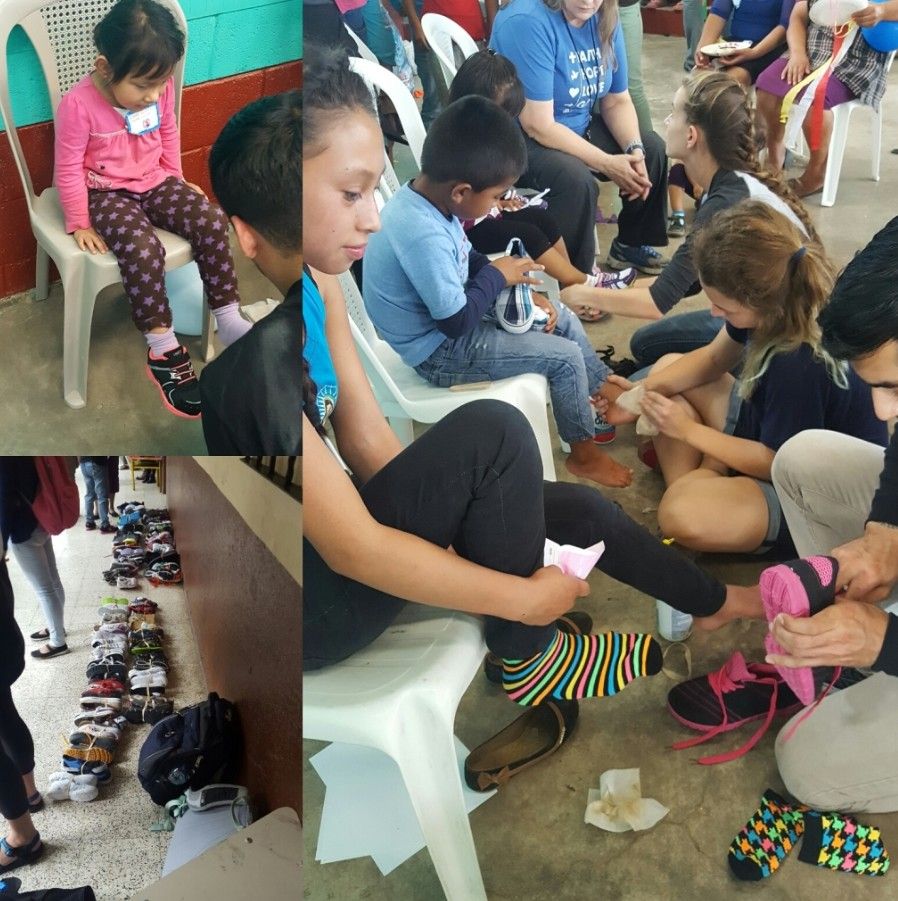
After working with children all morning, I was a little nervous about working with one of the mothers. As I sat on the floor in front of her chair, I knew the only thing she could possibly say that I would understand was “Hola” so I decided to be the first to say it in an effort to at least express friendliness even if I couldn’t verbally show it in any other words. She responded with “Hola” and continued with a few words of her own. I looked around the crowded room and couldn’t find an available interpreter, so I held my hands palms up, shrugged my shoulders, smiled and said “no Espanol.” I wasn’t even sure if I had said that correctly, but I knew she understood from her “ah” and nod.
I untied the laces of the shoe she wore on her right foot and gently removed her shoe and sock. Then I picked up the new shoes and started to remove the new socks that were stuffed inside. My first thoughts upon seeing those new socks were, “I cannot give her these. What am I supposed to do with these things? She is not going to want them. Where is an interpreter to explain how sorry I am that this is what I’m giving her? I wish I had my own bag with me, so I could just give her one of the new pair of socks I had packed for myself.” I now wish I knew how many of those silent thoughts she could see on my face.
She hadn’t seen her new socks yet since I hadn’t completely removed them from the shoe they were stuffed into and unrolled them, and I really didn’t want to show them to her. I quickly glanced around the room again for an interpreter or someone who would hopefully be able to find me a new pair of socks, but no miracle showed up…or so I thought.
I know I must have worn a cringe on my face as I unrolled the pair of knee-high striped socks. Oh, how I wished in that moment the only thing unusual about this woman’s new socks was the length and striped print! As I finished unrolling and separating them, she saw what I saw around thirty seconds earlier. One sock had blue and white stripes while the other had green and white stripes. Even that was not the most unusual thing about these socks. They had toes. Toes…like the socks I had been given years earlier as a gag-gift for Christmas. I was presenting this woman who was older than my forty-four years with a pair of socks that came to her knees, were different colors, and had the toes separated.
I was expecting her to look at me with an expression that would say not only “no” but “are you kidding me.” In afterthought, I think I was more surprised by her response than she was about the socks. Here’s when I realized the miracle. She just laughed. She wasn’t upset. She wasn’t bothered in the slightest. She didn’t seem even the tiniest bit disappointed. She laughed and her smile showed as much in her eyes as it did on her mouth. Then her laugh became contagious. Neither of us could stop laughing as I washed her foot and put the sock on. We laughed even harder when we realized the toes on the socks were longer than the toes on her feet which made it even more complicated to make sure I had only one of her toes in each toe of the sock. Have you ever tried a pair of toe-socks? They can be hard to put on your own feet. They are really difficult when you are putting them on someone else’s feet.
Eventually, we managed to get all ten of her toes in the correct places, and I put her new shoes on. She expressed her thanks, left her seat, and a child took her place on the chair in front of me. The next hour or so was uneventful. I washed several pair of feet and replaced worn shoes and socks with new ones. As my team members and I were finishing up with our last few pair of feet, I felt a hand on my shoulder. I turned to find the woman I had laughed with about her crazy socks. She embraced me with the biggest hug and again thanked me. We shared another laugh and each went our separate ways, knowing we would never see each other again, but I believe both of us felt a special bond was formed between us…over two crazy, miss-matched socks.
Our bond was formed on day two of a mission trip with Buckner International. My daughter and I were blessed with an all expense paid trip that I won through the WayFM radio station. We spent one week in Guatemala teaching vacation Bible school followed by giving the kids and a few parents and grandparents shoes. We told stories, helped them memorize a Bible verse, made crafts and played recreational games with more children and families than I could count. When those activities were over, we turned to the socks and shoes.
I have heard many people compare the foot washing we did to when Christ washed the feet of his disciples prior to His crucifixion, but I have a hard time making that comparison to my own actions. As I sit here now in my seat on the flight home and think back on the last week, I feel more like Mary who washed Jesus feet while he was in Bethany; but instead of washing the feet of Jesus, I was washing the feet of His disciples in His physical absence. This woman, Mary, was not a saint. She was a sinner just like the rest of us. “When the Pharisee who had invited him saw this, he said to himself, ‘If this man were a prophet, he would know who is touching him and what kind of woman she is – that she is a sinner.’ (Luke 7:39) She was also criticized for using valuable oil to wash Jesus’ feet. “But one of his disciples, Judas Iscariot, who was later to betray him, objected, ‘Why wasn’t this perfume sold and the money given the to the poor? It was worth a year’s wages.’ (John 12:4-5)”
The only One who could truly judge this woman was Jesus Christ but He chose to extend the grace and mercy only He can give. “Then Jesus said to her, ‘Your sins are forgiven…Your faith has saved you; go in peace,’ “(Luke 7:47,50). She couldn’t hide her sin, but she could rise above it. She could make the most of her resources to honor Jesus Christ, and for that He praised her and her story was given an honored place in Scripture. I am not looking for fame and honor or even recognition for participating in this mission trip. I, like this woman, just want to honor Jesus Christ in whatever way I can, and I want to spread His love around the world. If that simply means talking to my neighbors, my co-workers and other people who cross my path about what Jesus has done for me, I will do it. If that means putting a pair of crazy, miss-matched socks on someone’s feet, I will do that, too.
This story was originally shared under the title “Crazy, Mismatched Socks” on my other blog in 2017 – forgivenfaith.wordpress.com.
“John 12:4-5; Luke 7:39, 47,50.” NIV Archeological Study Bible: An Illustrated Walk through Biblical History and Culture. Grand Rapids, MI: Zondervan, 2005. N. pag. Print.
Yesterday, while scrolling through Facebook, I read my friend Beverly’s happy birthday message for her mom. The post included several pictures of family members with the woman being celebrated, including one in which Beverly’s mother was with her twin sister, Beverly’s aunt. The caption to this photo described it as the twin sisters together before her aunt “moved to heaven.”
What a beautiful way to mention a loved one who was no longer with them here on earth, that was! She didn’t die. She didn’t pass on. She didn’t leave them. She simply moved her residence to a new address.
This reminds me of the Bible study I’ve been reading with another friend, Heaven: When Faith Becomes Sight by Jennifer Rothschild. I’m not done reading this Bible study yet, but I can already say the author has done an amazing job of answering some questions about heaven and helping put other questions that don’t have easy or clear answers into a healthy perspective.
Jennifer Rothschild uses Scripture and inspirational teaching from other Bible scholars to lead the reader down a path of understanding what our finite minds can about our eternity. “Let not your heart be troubled. Cast your eyes past the shadows of this life to that bright beautiful forever God has for you” (Rothschild, 2025, p. 34).
As I read through this study, I will share things that “jump off” the pages at me. I pray you find something in the words I write that will lead you to pick up this Bible study and read it for yourself. Until then, I’ll leave you with this message from the Apostle Paul in 1 Corinthians 13:12, “For now we see only a reflection as in a mirror; then we shall see face to face. Now I know in part; then I shall know fully, even as I am fully known.”
Rothschild, J. (2025) When faith becomes sight, Heaven. Lifeway Press.
Have you ever traveled through Tennessee, Alabama, or Georgia, and noticed a hill covered in green, leafy vines that grow so quickly they have taken over the landscape and even crawled up the trees hiding the tree trunks and branches? Those green leaves are probably part of the kudzu vine, a plant native to Asia, which has invaded much of the southeastern United States. There is one place along Interstate 65 in Alabama that I used to pass fairly often where the kudzu vines had taken over an abandoned railroad track and even swallowed the abandoned train cars. Kudzu is an invasive species doing what invasive species do – taking over and replacing the ordinary with itself.
Reading about the kudzu vine is the first time I paid much attention to the effects of an invasive species. The term “invasive species” now stands out to me every time I hear it, and I heard it the other day in an unexpected place – a Bible study.
I had no idea that some species of mustard plants are considered invasive species. Kristi McLelland, author of the Luke in the Land and the Gospel on the Ground Bible studies, joked that if you stand still for too long, the mustard plant will start growing right up your leg. After hearing her description of it, I went to Google, and, sure enough, mustard is an invasive species that will quickly overtake a field.
I have always heard, through sermons and Bible studies, the mustard seed compared to faith in terms of Luke 17:5-6. “The apostles said to the Lord, ‘Increase our faith!’ He replied, ‘If you have faith as small as a mustard seed, you can say to this mulberry tree, ‘Be uprooted and planted in the sea,’ and it will obey you'” (NIV). Imagine having the faith to make something happen just by saying it, but using this seed as an analogy for power isn’t all Jesus had to say about the mustard seed.
In Matthew 13:31-32, “He told them another parable: ‘The kingdom of heaven is like a mustard seed, which a man took and planted in his field. Though it is the smallest of all seeds, yet when it grows, it is the largest of garden plants and becomes a tree, so that the birds come and perch in its branches'” (NIV). If we plant the tiniest seed of faith, it will grow just like the tiniest seed of the mustard plant; and it will spread like an invasive species. It will invade your own life and the lives of those you are around, replacing the ordinary with itself – the extraordinary.
But how do you plant a mustard seed of faith and make sure it becomes invasive? You use Bible study as a fertilizer in your own life – your mind and heart; you use time with Christian friends to pull weeds and water your mustard seeds of faith; and, as Kristi says repeatedly in her Bible studies, you feast on the Word of God.
McLelland, K. (2022). The gospel on the ground. LifeWay Press.

 How a Mustard Seed Grows