Have you ever traveled through Tennessee, Alabama, or Georgia, and noticed a hill covered in green, leafy vines that grow so quickly they have taken over the landscape and even crawled up the trees hiding the tree trunks and branches? Those green leaves are probably part of the kudzu vine, a plant native to Asia, which has invaded much of the southeastern United States. There is one place along Interstate 65 in Alabama that I used to pass fairly often where the kudzu vines had taken over an abandoned railroad track and even swallowed the abandoned train cars. Kudzu is an invasive species doing what invasive species do – taking over and replacing the ordinary with itself.
Reading about the kudzu vine is the first time I paid much attention to the effects of an invasive species. The term “invasive species” now stands out to me every time I hear it, and I heard it the other day in an unexpected place – a Bible study.
I had no idea that some species of mustard plants are considered invasive species. Kristi McLelland, author of the Luke in the Land and the Gospel on the Ground Bible studies, joked that if you stand still for too long, the mustard plant will start growing right up your leg. After hearing her description of it, I went to Google, and, sure enough, mustard is an invasive species that will quickly overtake a field.
I have always heard, through sermons and Bible studies, the mustard seed compared to faith in terms of Luke 17:5-6. “The apostles said to the Lord, ‘Increase our faith!’ He replied, ‘If you have faith as small as a mustard seed, you can say to this mulberry tree, ‘Be uprooted and planted in the sea,’ and it will obey you'” (NIV). Imagine having the faith to make something happen just by saying it, but using this seed as an analogy for power isn’t all Jesus had to say about the mustard seed.
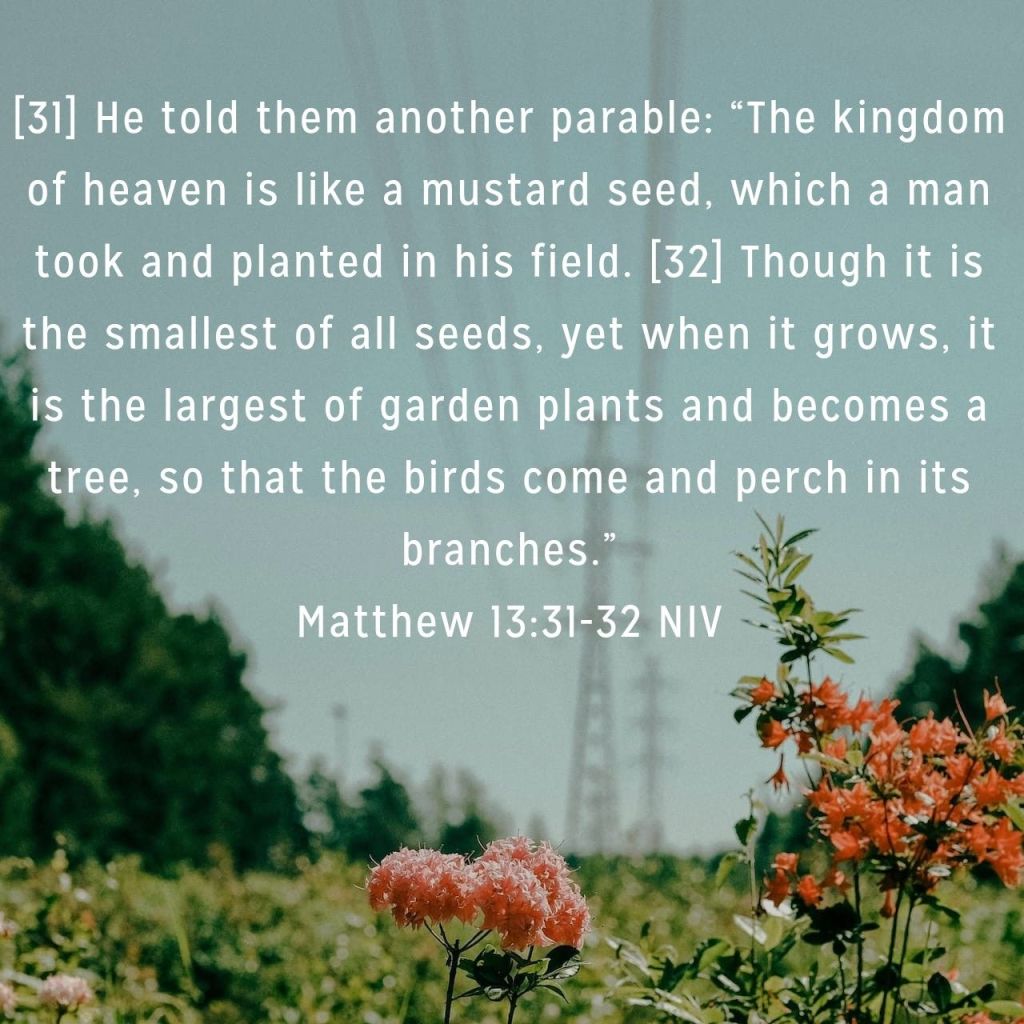
In Matthew 13:31-32, “He told them another parable: ‘The kingdom of heaven is like a mustard seed, which a man took and planted in his field. Though it is the smallest of all seeds, yet when it grows, it is the largest of garden plants and becomes a tree, so that the birds come and perch in its branches'” (NIV). If we plant the tiniest seed of faith, it will grow just like the tiniest seed of the mustard plant; and it will spread like an invasive species. It will invade your own life and the lives of those you are around, replacing the ordinary with itself – the extraordinary.
But how do you plant a mustard seed of faith and make sure it becomes invasive? You use Bible study as a fertilizer in your own life – your mind and heart; you use time with Christian friends to pull weeds and water your mustard seeds of faith; and, as Kristi says repeatedly in her Bible studies, you feast on the Word of God.
McLelland, K. (2022). The gospel on the ground. LifeWay Press.


Thank you Holly for this insightful interpretation——thinking about faith being invasive—I love it.
LikeLike
Thank you, Cathy!
LikeLike